

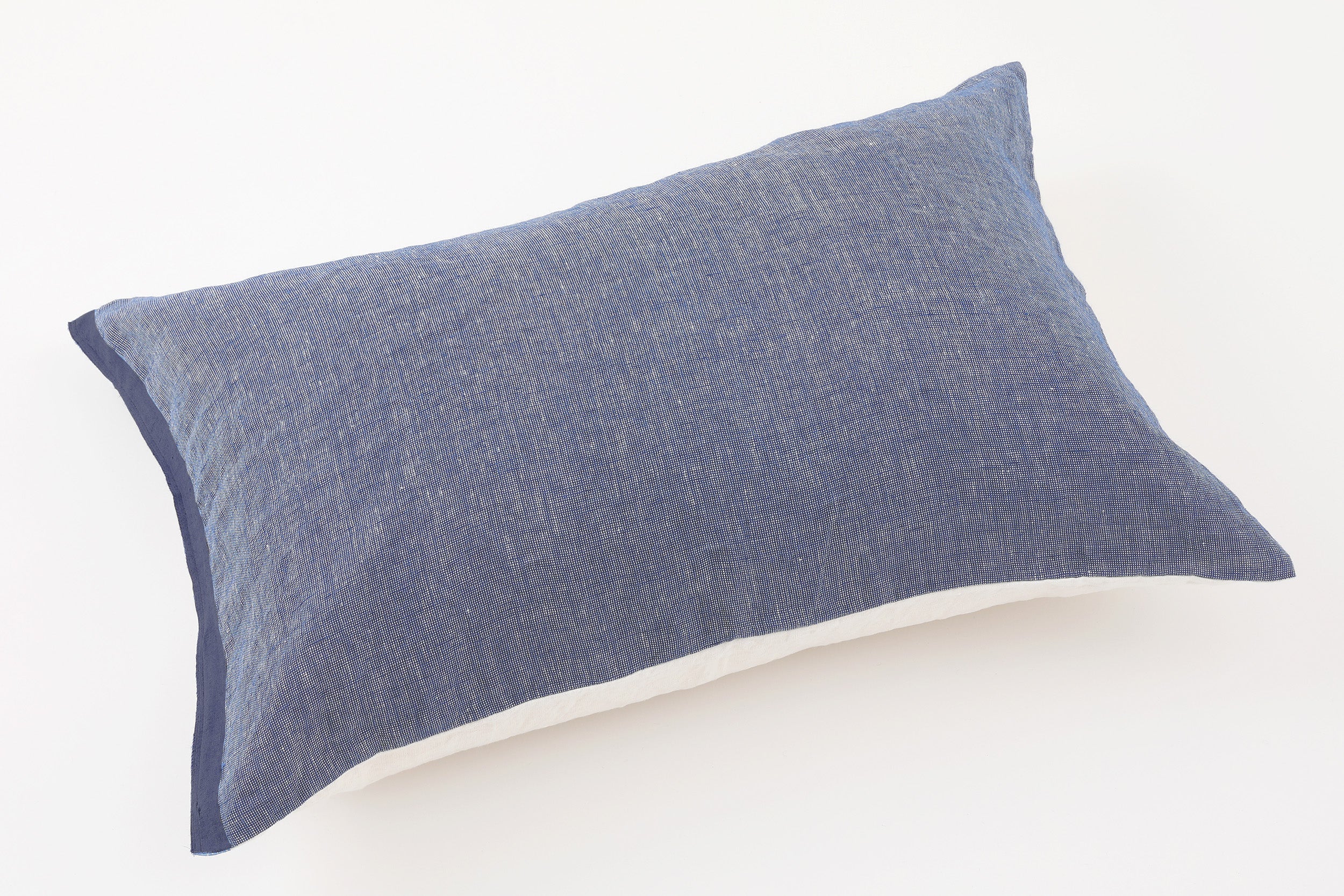
Indigo-dyed selvedge linen pillow case
How about gift wrapping?
If you would like gift wrapping, please add 660 yen (tax included) to the " Gift-Wrapping " option that will appear after you press the "Add to Cart" button.
Choose options


About Indigo-dyeing
Tenjin-factory's indigo dyeing process is based on the traditional Japanese method of lye fermentation), which is carried out by skilled indigo dyeing masters. The process of making the dye solution used for indigo dyeing is called "akuhakkodate" in japanese. It means lye fermentation. Indigo dyeing is a process in which the dye solution is made using only natural ingredients. They raise a bacterium called "reduction bacterium" as if it were their own child, and change indigo, the source of blue color which is normally insoluble in water, into water-soluble. To energize the bacteria, several sources of nutrients are provided. They too will be all natural. The dye solution made in this way is so safe that it can be spread on fields as fertilizer after it has served its purpose. Linen yarns dyed by carefully repeating the process of dyeing => washing => drying over and over again with such safe dyeing solution are woven into sheets. The indigo dyeing process, which is carefully carried out using traditional dyeing methods, does not cause color migration, so there is no need to worry about staining other clothes when washing.

About Tenjin-factory's fabrics
We started weaving on old-fashioned analog shuttle looms with the aim of returning to the humanistic approach to manufacturing that has been lost due to mass production and mass consumption. Shuttle looms are like hand looms powered by electricity. It still requires human hands to make cloth. The advent of the latest looms, which require as little human labor as possible in the name of labor saving, has certainly realized mass production, but on the other hand, the cloth-making site where the warmth of hands still remains has disappeared. Tenjin-factory was born as a textile factory where people make cloth and the loom is only a tool.
The shuttle loom is characterized by its ability to weave without putting a load on the threads, making it possible to create soft, nostalgic, and warm fabrics. Its charm also lies in the fact that it produces a linen fabric with a selvedge, just like antique linen. In the process of weaving the cloth, parts called selvedge are formed at both ends. Traditionally, selvedges have been marked with colored threads so that people can tell who made them. This has somehow become a part of the design. Tenjin-factory also weaves original selvedges into various linen fabrics.
Selvedge is a sign of good quality.


What is the pillow case made of selvedge fabric?
Tenjin-Factory's selvedge linen, like antique linen, the selvedge itself is part of the design. The selvedges are cut to fit the size of the pillow, so the selvedges are only on one side, but the selvedges are worth having. This pillow case is made with artisanal fabrics that will be antique in 100 years.


Making pillow case just for you
This product is made to order.
If fabric is available, delivery will take about 2 weeks. If fabric is not available, you may have to wait up to 3 months.


About Size
If the cover size is indicated on the tag of the pillow, please order it in that size. If not, please measure the width (long side) and length (short side) of the pillow. The trick to measuring is to pinch both corners and measure the length of the pillow when it is stretched. Also, please measure it in centimeters.
Product Data
| Material |
100%Linen
| Size |
| Made in Japan |
We can ship to world wide from Japan. However, in some cases there are some countries and regions that we cannot ship to.
| Delivery Date |
If fabric is available, delivery will take about 2 weeks. If fabric is not available, you may have to wait up to 3 months.