
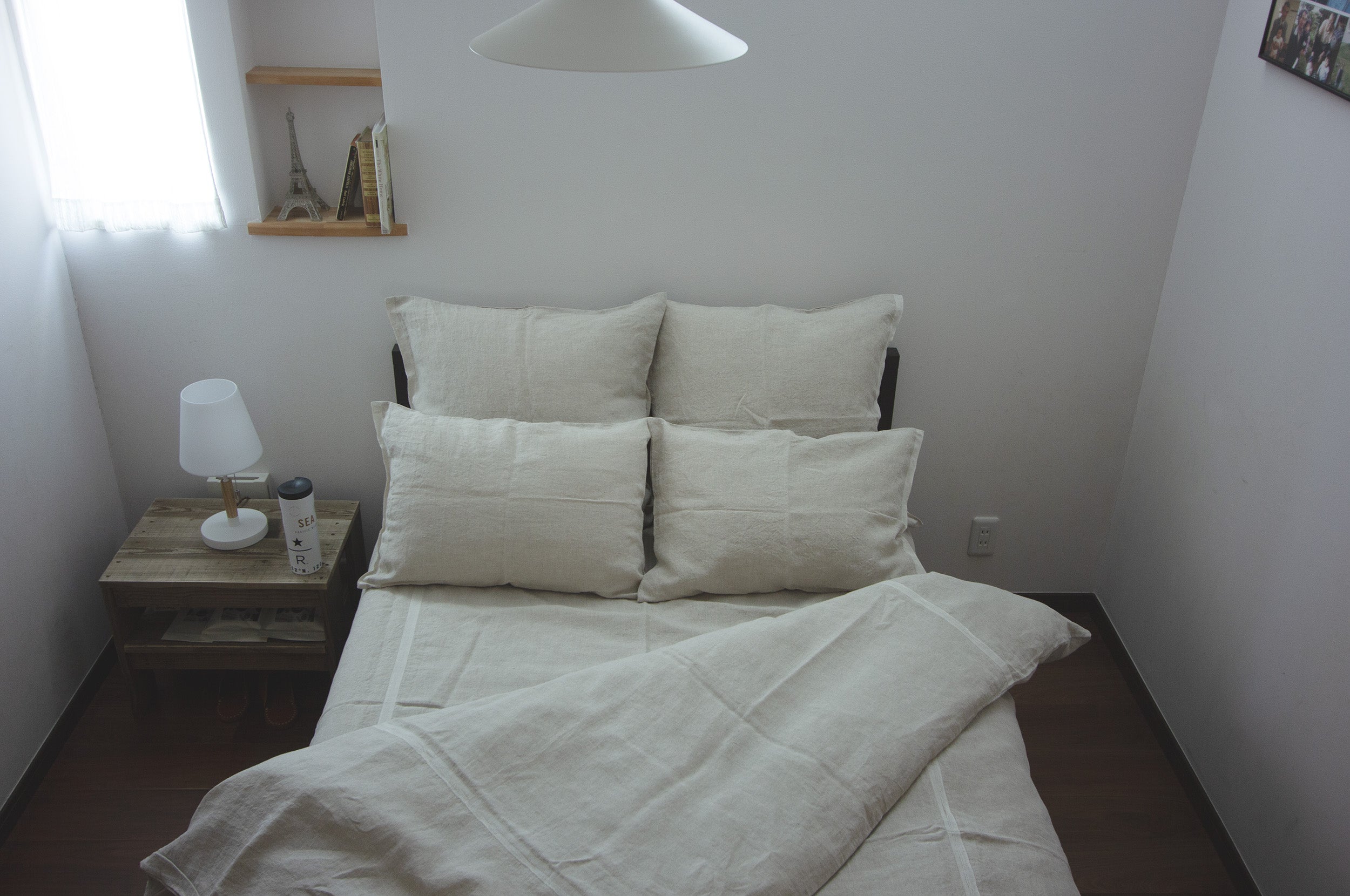
Linen-Gray selvedge linen comforter case
How about gift wrapping?
If you would like gift wrapping, please add " Gift-Wrapping " for 660 yen (tax included) on the cart page.
Choose options
Linen comforter case with non-dyed yarn
Linen meets an old-fashioned shuttle loom.
Linen, a yarn from flax grown in Europe and shuttle looms capable of weaving selvedge linen, which is the same as antique linen, met at Tenjin-factory and became woven fabrics.
Linen made from flax, which grows only with rain and soil, has benefited mankind throughout its long history. It has enabled us to live comfortably on this earth through its natural water absorbency, quick-drying, breathability, and heat retention properties without the need for human intervention.
The bare color of linen is called "linen gray. The fiber in the flax stalks is removed through a process called retting, in which the harvested flax is spread over the fields so that the stalks can be removed by natural forces such as natural rainfall, dew, and even bacteria in the soil, which corrode the stalks. It is said that the color of linen gray is determined at this time. In other words, the linen gray color varies depending on the year it is grown, the land it is grown on, and even the weather that year. It is truly a once-in-a-lifetime color woven by nature.
Today, artificial yarns and fabrics woven from artificial yarns and dyed with chemical dyes are the mainstream. Although they are convenient and reasonably priced at first glance, it is well known that they are not environmentally friendly and will soon return to nature.
In this way, linen gray fabrics can be called "nature's color woven by nature.
Because it is the color of nature, linen gray is a color that fits in well with our lives. These comforter cases are made of 100% natural materials that are gentle to the eyes and skin.
Please try them and see for yourself.

Eco friendly duvet cover

Linen fabrics are made from this plant
The plant is called flax
That plant is woven into these fabrics.

Textiles are made through several processes

Dyeing

Warping

Drawing

Tyeing

Weaving
About linen
Flax that grows only in the rain and soil has benefited mankind throughout its long history. It has enabled us to live comfortably on this planet through its natural water absorbency, quick-drying, breathability, and heat retention properties without human intervention.
The flax plant is a versatile plant, from the seeds of which linseed oil can be extracted, and from the stalks of which fiber for weaving can be obtained. Because of these characteristics, it is considered an excellent agricultural crop, and its cultivation seems to have flourished even in ancient Egypt. Today, Europe is the main producer of flax for textiles, with France, Belgium, and the Netherlands accounting for 85% of total production.
The fiber is extracted from the inner part of the stem, which has hollow pores. These hollow pores allow water and perspiration to soak in easily, enhancing water absorbency, while at the same time allowing it to dissipate and dry quickly, keeping the skin feeling dry and smooth without being sticky. On the other hand, when you feel cold, air warmed by your body heat enters the hollow pores to keep your body warm. In other words, linen can be used comfortably throughout the year.
In addition, linen can be washed repeatedly. Each time you wash it, the texture will soften, feeling even better.
Linen is a pleasure to use.

About Tenjin-factory's fabrics
We started weaving on old-fashioned analog shuttle looms with the aim of returning to the humanistic approach to manufacturing that has been lost due to mass production and mass consumption. Shuttle looms are like hand looms powered by electricity. It still requires human hands to make cloth. The advent of the latest looms, which require as little human labor as possible in the name of labor saving, has certainly realized mass production, but on the other hand, the cloth-making site where the warmth of hands still remains has disappeared. Tenjin-factory was born as a textile factory where people make cloth and the loom is only a tool.
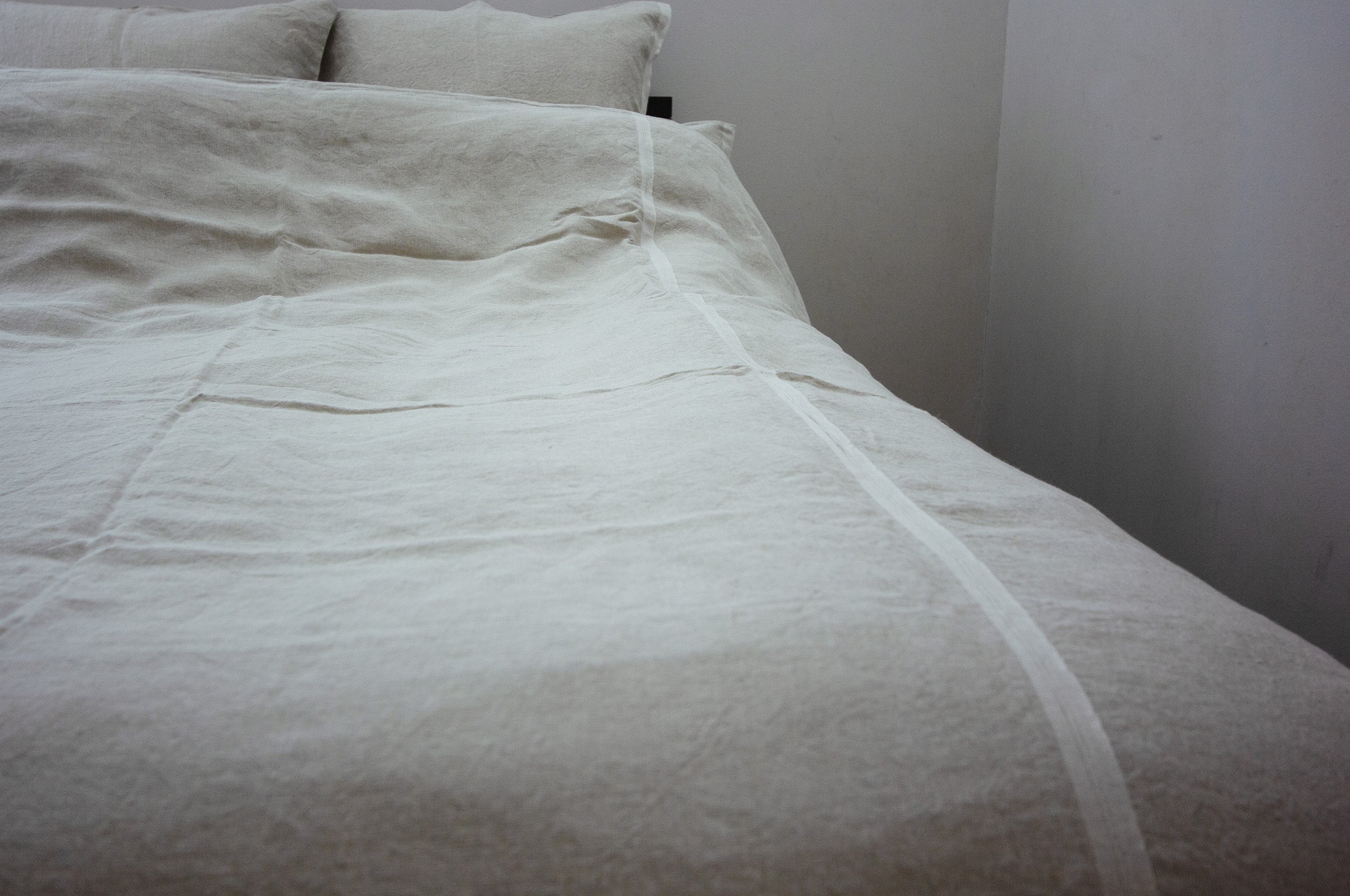
The shuttle loom is characterized by its ability to weave without putting a load on the threads, making it possible to create soft, nostalgic, and warm fabrics. Its charm also lies in the fact that it produces a linen fabric with a selvedge, just like antique linen. In the process of weaving the cloth, parts called selvedge are formed at both ends. Traditionally, selvedges have been marked with colored threads so that people can tell who made them. This has somehow become a part of the design. Tenjin-factory also weaves original selvedges into various linen fabrics.
Selvedge is a sign of good quality.


What is the comforter case made of selvedge fabric?
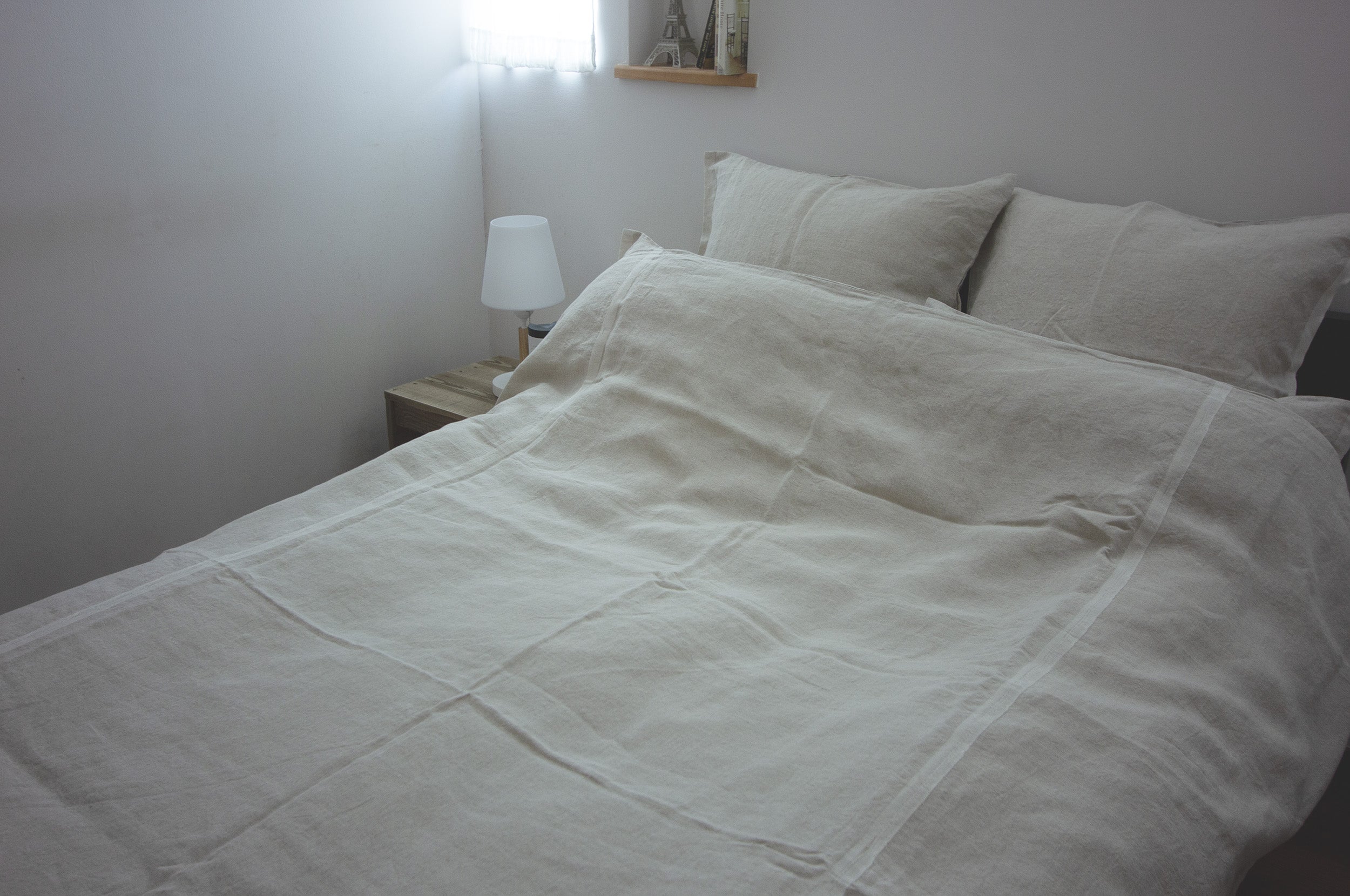
In order to accommodate various sizes from different countries, Tenjin-factory's bed linens are joined together at the selvedge. The thickness of this part is half that of the main part so that it does not become thicker when overlapped. So the overlapping areas will not cause you discomfort. In addition, as with antique linen, the selvedge itself is part of the design of Tenjin-factory's selvedge linen. These comforter cases are made from fabrics that will be antique 100 years from now.

Making comforter case just for you
This item is produced on a made-to-order basis.
When the fabric is in stock, delivery takes about one month;
when it is not, please allow up to three months. Because the comfortercases are completely made-to-order, it will take some time for us to deliver freshly made comfortercases to you. Our skilled craftsmen hand cut the selvedge linen fabric woven on an old-fashioned shuttle loom, and then sew the comfortercases. Please look forward to the arrival of these carefully crafted comfortercases.

About Size
If the cover size is indicated on the tag of the comforter, please order it in that size. If not, please measure the width and length of the comforter. Also, please measure it in centimeters.
For reference, typical comforter sizes are as follows.
< Comforter size >
| US bed size | US comforter size |
| Twin | 159 x 219 |
| Twin XL | 159 x 219 |
| Full | 199 x 219 |
| Full XL | 199 x 234 |
| Queen | 229 x 229 |
| King | 264 x 234 |
| California King | 264 x 234 |
| AUS bed size | AUS comforter size |
| Single | 140 x 210 |
| King Single | 140 x 210 |
| Doublel | 180 x 210 |
| Queen |
210 x 210 |
| King |
245 x 210 |
| Super King | 270 x 240 |
| JP Bed size | JP comforter size |
| Single | 150 x 210 |
| Semi Double |
170 x 210 |
| Double | 190 x 210 |
| Queen |
210 x 210 |
| King |
230 x 210 |
Product Data
| Material |
100%Linen
| Size |
| Made in Japan |
We can ship to world wide from Japan. However, in some cases there are some countries and regions that we cannot ship to.
| Delivery Date |
This product is made-to-order. It takes about 3 months for delivery.
How to care products
1. Washing
Wash in a frictionless manner. Hand washing is recommended, but if using a washing machine, be sure to put it in a net and wash it alone. Fluff may fall out in the beginning, but this will become less of a concern after repeated washing.
2.Detergent
Use a neutral detergent. Do not use detergents containing bleach or optical brighteners. Also, please avoid using fabric softener.
3.Water temperature
We recommend room temperature water for washing.
4. Dryer
Please use delicate mode. Otherwise, it may cause shrinkage.